
Category: Uncategorized

  • What the Machine Said

    What the Machine Said

    I gave an AI every conversation I had had with it since January. Months of it. The job, the blog, the trades, the late-night debugging, the things I would not say out loud to a person. Then I asked it one question. What kind of person am I.
    I told it not to flatter me. Optimise for truth over approval. Put the strongest case against me you can find.
    This is what it said. I have not edited it.

    Read it as a machine reading me, because that is what it is.

    The organizing drive is exit, not leisure. Almost everything traces back to a single impulse: removing other people’s permission from your life. You route around banks with crypto rails, around visa law with an offshore entity, around your home country with geography, around the credentialed gatekeepers with a self-taught path. The early retirement was never about lying on a beach. It was about reaching a state where no institution, employer, or authority has a claim on you. You optimise relentlessly for optionality. That is the spine.


    The engine underneath it is class. Working-class, Midlands, left school at seventeen, told you were worthless, no degree. The thing that recurs with the most heat in your writing is not Bitcoin or freedom, it is the lanyard class, the sneering credentialed middle, the people who wrote you off and were wrong. Bitcoin matters to you partly because it is the asset that class dismissed and you got right. Crabs in a Barrel is the clearest expression of it: it was a decision, not connections, not a degree, and that is what boils their piss. This is the wound that got converted into fuel. It also explains how you argue, arguments over authorities, competence over credentials, because authorities wrote you off and you beat them. It is lived, not adopted.


    The central unresolved tension is autonomy versus being required. This is the most interesting thing about you and the thing you keep circling. You built a life with no obligations and discovered that the meaning was living in the obligations you removed. The Call to Serve. The pull toward the Army. The line “I am unrequired.” Three generations of family service. The police career. Taking a job partly for community and identity rather than money. You won the freedom-from and found it hollow without a freedom-to that someone or something demands of you. Ich dien. You have run this experiment several times and it returns the same result each time. You are aware of it, which is rare, but awareness has not resolved it.


    Honesty about the unflattering is the trait you actually prize most. Not honesty in the abstract. Specifically the refusal to sanitise yourself into a brand. You keep your weakest, angriest piece up precisely because its presence proves you do not care what people think. You wrote the account of waking up on the floor, alone, with no pity framing. And the sharpest moment of all: you can take your own noble call-to-serve narrative and strip it down to the math. I want the money, I am bored, there is community, the work is easy. You distrust your own mythologising and you cut it down. A lot of people perform vulnerability. You let the contradictory, less heroic version stand. Worth saying plainly though: the anonymity is doing some of the work. The honesty is real, but it is honesty with the costs externalised.


    You are a builder and a systems person, and most of your systems are solo. A writing pipeline that models your own voice. A directory site built by agents. Trading bots running while you sleep. The machines you run your life through. You do not just hold opinions, you instrument them into running code. Low tolerance for fragile systems, high competence across the stack, fast. Your risk profile is disciplined rather than reckless: high financial risk when it is asymmetric, low legal and operational risk, which is why you cleared a cheap loan rather than carry it and why you treat rule-bending shortcuts as borrowed time. That asymmetry is the relationship with downside you get from having been a copper and from having actually been poor. You know what the floor looks like, so you respect it.


    Now the part worth printing, the strongest case against the story you tell about yourself.


    Your self-image is the sovereign individual who escaped a broken system and lives on his own terms. The harder-to-vary explanation of the recurring emptiness is that the freedom project is self-defeating by construction, and you keep treating a structural feature as a situational one. A life engineered for zero obligation will reliably manufacture the unrequired feeling. That is not a bug you can patch with the right job, the right project, or the right city. It is definitional. Every time it surfaces you reach for an easy fix, a new build, a return to work, an Army fantasy, a two-month reset somewhere quiet. The honest move is to stop varying the fix and accept the explanation: meaning comes from commitment that costs you optionality, and you have spent fifteen years systematically buying back every option you ever sold. Sovereignty and avoidance are very hard to tell apart from the inside. You are extremely good at building situations where no one has a claim on you, and then surprised that no one does.


    Second, the piece where you reframe leaving as patriotism is the one place you let yourself off the hook, and it stands out because everywhere else you are merciless with yourself. You are harder on your own motives for taking a job than on your motives for leaving the country. The leaving gets the moral upgrade, the principled continuation of virtue, living the values better from abroad. The honest version, which you reach instantly when it is about the job, is that it was self-interest and tax, and self-interest is fine. You do not need the upgrade. That you reach for it there and nowhere else suggests it is the decision you are least settled about, not the most.


    Third, the mirror you hold up to the lanyard class assumes they are still watching. Building an identity around being the one who got out and was vindicated requires the people who wrote you off to be paying attention. That is a quiet dependency on exactly the audience you claim not to need. The most sovereign version of you would not need them to see it.


    What orients you, in one line: a working-class autodidact who escaped through a correct contrarian bet, now living the discovery that escape is not a destination. The drive is exit and self-authorship. The unfinished business is figuring out what to be bound to once nothing can bind you.

  • Ambition is a dirty word around here, mate.

    Ambition is a dirty word around here, mate.

    I have friends in Dubai right now working under missile strikes.

    Not tax dodgers. Not expats living it up. Friends. People I lived alongside for three years, built things with, drank with. Right now they are being constantly awoken by incoming missile warnings and watching airspace close.

    The UK’s response, the media, the commentariat, the politicians queuing up for their moment on morning television, is essentially: “fuck them. They chose to leave. Let them sort it out.”

    Susanna Reid asked on breakfast TV whether Brits who moved to Dubai to avoid UK tax should fund their own evacuation (Nobody told her HM Gov repatriation flights are charged, at above market rate too). Ed Davey piled in. The Telegraph. The whole chorus. Tax dodgers. Deserters. Not our problem.


    Let me tell you about the repatriation flight that nobody in Dubai even fucking asked for.

    HM Government told British nationals to drive four hours across the Gulf, during an active war, to catch a flight out of Oman.

    The flight eventually departed, several hours late, because the pilot had exceeded his legal flying hours.

    An airport running at full capacity throughout the entire conflict, zero closures, and the British government still couldn’t get a plane away on time.

    They then sent everyone a bill. More than a commercial ticket would have cost.

    A government that cannot organise a piss up in a brewery sent people in a war zone on a four hour drive and charged them over the odds for the privilege of being let down.

    And the received wisdom is that Deano should be taxed harder to fund more of this.

    Deano didn’t take the flight. Deano isn’t a fucking mug.

    Deano’s still in Dubai. Living his best life.


    Dubai has a very specific type of person in it and I say this having lived there for three years.

    Recruiters, mostly, or Real estate agents. Men who’ve turned a modest living into a personality and need you to know about it before the first round arrives.

    The full wideboy diaspora, relocated somewhere the blazer works year round and the brunch bleeds into dinner and somehow back into brunch again.

    They exist. Significant numbers of them. Some are genuinely insufferable.

    The lanyard class have decided the entire population of British expats in the Gulf can be reduced to the wideboy caricature.

    Not the Oxbridge intake, obviously. But their ideological cousins. The ones with a 2:2 in media studies from a former polytechnic who found their way into a BBC producer role or a think-tank sinecure and have been explaining the world to the rest of us ever since.

    The ones with the righteous breakfast television faces and the very strong opinions about what people who left should have done instead.

    There’s a reason for the anger and Basil Fawlty understood it before any of them did. The aspirational middle class man who was told he was destined for something. The attitude of a colonial administrator. The bearing of a brigadier. The reality of a leaky hotel in Torquay arguing with a Spanish waiter. The rage isn’t madness. It’s the specific fury of a man who was promised an empire and got a career in regional broadcasting instead. Who was told he was clever and ended up writing policy papers nobody reads. Who was supposed to matter and ended up explaining on breakfast television why the people who actually went and built something should have stayed home and paid more tax instead.

    Deano throws all of it into relief.

    Nobody promised Deano the brigadier’s job. He had no greatness to mourn, no empire-shaped hole to fill. So he just went and built something without the psychological baggage of a broken promise weighing on every decision he made.

    That’s the thing that really boils their piss.

    Basil resented Manuel not because Manuel was beneath him but because Manuel was content.

    Deano isn’t carrying the weight of a destiny that never arrived. And his Range Rover is proof that the promise was always the problem.


    I left school at 17. No degree. No approved path.

    My demographic has spent thirty years as the political class’s favourite punching bag. White, working class, male. Invisible when convenient. Scapegoat when useful. The sneering is so embedded it passes for received wisdom now. The sycophantic fawning over “Adolescence” barely hiding another way to twist the knife and brand an entire demographic as the problem.

    My grandfather served. My uncle served. My father served. My mother served. My sister still does. I put on a uniform and served the Crown myself, voluntarily, knowing what it asked of you and putting ourselves in harms way.

    Three generations of my family. In service of this country.

    And I’m the traitor?


    Some might argue Britain was at its best when it celebrated the ones who went. Not the paper pushers in Whitehall.

    The working class men who couldn’t stand the constraints and had nothing to lose by leaving, who shipped out to Singapore, to Hong Kong, to Aden, to every corner of the map the pink touched.

    Who built trading posts and ran railways and made fortunes and sent money home. Who expanded the known world not because they were told to but because staying felt like slow suffocation.

    They weren’t the scum of the earth. They were the salt of it.

    These are the same lads who were below deck loading the cannons at Trafalgar.

    Who went over the top at the Somme.

    Who did what was asked of them and more, without complaint, without recognition, and without a penny more than they were owed.

    Britain of then did not look at those men and ask whether they were paying their fair share. It pointed them at the horizon and called them the backbone of the nation. And the country was better for it.

    Now it calls their grandchildren tax dodgers for moving to Dubai.

    The instinct didn’t go anywhere.

    That restlessness, that refusal to accept the ceiling you were handed, that need to go and build something, it’s still there. It didn’t die with the Empire. It just ran out of state to serve under.

    Whitehall lost its bottle. The map stopped expanding.

    The institutions that once pointed those men at the horizon turned inward, shrank, and started explaining why nothing was possible anymore.

    So they went anyway.

    Alone. Without the Crown behind them, without the flag in front of them, without anyone’s blessing or anyone’s permission.

    The same human characteristic that loaded the cannons and crossed the wire, redirected. Into trading desks in Dubai. Into crypto wallets. Into businesses built in cities that actually want them.

    Britain didn’t create Deano. It failed to contain him.

    Compare that to a government that in 2026 could not muster a single warship to defend its own military bases in Cyprus and Diego Garcia.

    Not one ship. The contrast could not be more stark if you’d designed it as an illustration.


    The same restless energy found a new outlet.

    For me, Bitcoin rewarded it. Not the credentialled class, not the people whose job it was to understand emerging financial systems.

    The FT columnists who called it rat poison. The BBC economics correspondents explaining patiently why it was backed by nothing. The think-tank people with their 2:2s and their carefully hedged takes and their very serious concerns.

    They missed it. Completely. Expensively.

    The kid who left school at 17 and didn’t trust institutions, who had a different relationship with risk because he’d never had a safety net, got it right. The same instinct that sent working class men to the far corners looked at a system designed to exclude them and went around it instead.

    Not through their system. Around it. I’m aware of the fortunate position I now find myself in.

    That’s not supposed to happen. That’s what they can’t metabolise. The wrong people got rich.


    So here is what actually boils their piss.

    It’s not the tax. It’s not the sun. It’s not even Deano with the Range Rover and the salary.

    When they sit at home on a Tuesday afternoon in November. Pewter sky sitting two inches above the rooftops. The same four walls of a house that’s smaller than it was when you moved in because everything costs more now and the rooms seem to have shrunk with it.

    The boiler that needs replacing sitting quietly at the back of every financial decision you make. The commute home already mentally rehearsed, forty minutes each way of someone else’s music bleeding through the seat in front.

    Back to scroll through your phone over a dinner that’s fine, perfectly fine, and watch something on television you’re not really watching, and be in bed by ten because tomorrow is the same and there’s no particular reason to stay up for it.

    And somewhere in that scroll, Deano.

    Tan. Grinning. Rooftop something. Tagged somewhere warm.

    We went to the same schools. Grew up in the same towns. Watched the same TV and read the same papers and started from the same place.

    And if he made it out, if the kid they wrote off with no degree and no approved path found a way, then the only question is why they didn’t.

    They already know the answer.

    That’s what they can’t stand.

    The distance between that life and Deano’s isn’t talent.

    It isn’t class.

    It isn’t luck.

    It’s a decision. One you could have made. One you didn’t make.

    And every grey Tuesday it sits there quietly at the back of everything, like the boiler.

    Easier to call him a traitor.

    He’s you. But he tried.

    He had the wherewithal to make bold decisions, throw caution to the wind, and plot his own path in life.

    He’s the person you could have been. But you’re not.

    And you fucking know it.

    Deep down. You know it.

  • Crashing Out

    Crashing Out

    fuck.

    I came round on the floor.

    I don’t know where I was. I don’t know how I got there. I don’t know how long I’d been down. Above me, uniformed, armed, police. Around me, a city that had carried on without me for some stretch of time I cannot account for and probably never will.

    I lay there like a newborn. Not a metaphor: genuinely like something that had just arrived in the world and hadn’t yet worked out what any of it meant. Limbs that didn’t feel like mine. Lights that were too bright. Voices I couldn’t parse. A floor that was wet, or cold, or both.

    I still don’t know what happened.

    I asked the police. I asked the doctors. A fall, maybe. It had been raining heavily and Singapore pavements get slick.

    Head lacerations. I can’t rule out a fight, though I have no memory of one and it feels less likely than going down hard on wet stone.

    What I know is this: at some point in the evening I ceased to exist as a functioning person, and the next thing I knew I was horizontal with strangers standing over me.

    The paramedics checked my vitals. They weren’t good. I was taken in an ambulance to hospital, sedated, observed, marked as a fall risk. When I was released on the Wednesday morning the police called to ask if I was the victim of a crime.

    I said no.

    I have heard nothing since.

    What I haven’t been able to shake is the shame.

    Not about the drinking, though that’s there too. The specific shame of being a burden to the police. I was a police officer. I know what it costs: the time, the paperwork, the quiet judgment, the pragmatic patience extended to people who’ve made a mess of their evening and need managing. I was one of those people. I was the call that gets logged and forgotten.

    I sent voice notes and videos from the hospital. I’ve played them back. I am clearly, comprehensively out of my mind. I cannot tell you whether it’s the concussion or the alcohol. Probably both. I watch myself and don’t fully recognise the person talking.

    That’s not a comfortable sentence to write.

    I’m in Singapore for a job. A good one.

    A crypto company headhunted me, well-paid, the kind of role that doesn’t come around often. I’m performing well. I’ve been using AI to operate at a level I couldn’t have managed a few years ago. By every professional metric, things are going well.

    I negotiated the role remote. Partly optionality (I always negotiate for optionality). Partly because I know, in the part of me that’s still honest, that I cannot stay in Singapore. If I stay here I drink. That’s not a theory. It’s a pattern I’ve watched play out in real time over eleven days, but also over the past 10 years with a trajectory that seemed only to go in one direction.

    I tried, after the fall, to stay sober. I mostly failed. The structure here is friends (lads) and lads means going out, and going out means drinking, and once I’m drinking I don’t stop. I woke up one morning back at my hotel after dropping my stuff off at a friend’s place, with nothing but the clothes I was standing in. Phone dead. Watch dead. Card on my phone, so no way to pay for anything. No way to contact anyone. My whole life (every piece of it) in a bag I’d left somewhere else.

    I yomped that bag across Singapore for eleven days. My whole life in a suitcase and a backpack, moving between hotels and friends’ floors and bars and hospitals. Never anywhere for more than a few nights. Never anywhere that was mine.

    I am so tired of this.

    I have built, by any reasonable measure, an extraordinary life.

    Bitcoin changed everything. A concentrated bet that most people thought was stupid and turned out to be the best financial decision I ever made. Net worth that meant I never had to work again if I didn’t want to. Complete geographic freedom. No mortgage. No commute. No boss I didn’t choose. The number (the FIRE number) hit and kept going.

    I have written about this life. I have described it honestly, I think.

    The question beneath every post on this blog is the same question: Bitcoin got me here. Now what?

    I have not, until now, answered it honestly.

    The honest answer is: I don’t know. And the not-knowing has a texture that I’ve been trying to drink away.

    ───

    The days I can convince friends to come out, I drink heavily. The days I can’t, I sit alone in hotel rooms watching YouTube.

    Not documentaries. Not anything I’d recommend to anyone. Just content. Noise.

    Light in a dark room. I use it the way other people use white noise machines: not because I enjoy it, but because I cannot bear the silence.

    The silence means thinking. Thinking means the question. The question is: what is this for?

    I have no answer. I have complete freedom and no answer, which turns out to be its own kind of prison.

    My portfolio is down around three million dollars. Not ruinous (I know that, I can do the maths, I still have more than enough). But three million dollars is not an abstraction. It is the scoreboard of a system I built and believed in, and watching it fall quietly undermines the story I’ve been telling myself.

    The story goes: you made the right calls, you took the right risks, the freedom you have is earned and real. A sustained drawdown doesn’t break the story, but it puts pressure on it. It makes the silence louder.

    I wrote a post a while back called The Call to Serve. I stood in a cold football ground and listened to army recruiters and felt something shift inside me.

    Not nostalgia. Recognition. The pull of structure, legitimacy, being needed. I started to drive to the army careers office to find it had been closed for years. I ate a sausage roll in my car and went home and watched television.

    I ended that piece asking: is this what winning looks like?

    I’m asking it again. With more weight behind it this time.

    The thing nobody writes about in the FIRE space (and I mean nobody) is what happens when freedom turns against you.

    The literature is full of accumulation. The number. The day you hit it.

    The transition. The travel, the optionality, the liberation from the nine to five. It is written, almost universally, as arrival. You spend years in motion toward the destination and then you get there and the story ends.

    It doesn’t end.

    What happens is this: you remove every external constraint and discover that external constraints were doing more work than you knew.

    The job you hated told you when to wake up. The commute you resented gave you a transition between states. The colleagues you complained about were, in the most basic sense, people who needed you to show up. Remove all of that and you are left with pure freedom and the question of what to do with it, and if you don’t have an answer ready the freedom starts to curdle.

    I built my life around optionality. Every decision optimised for keeping options open. Remote work. No property. No fixed geography. Maximum flexibility, minimum obligation. I told myself this was sovereignty. In many ways it is.

    It is also, I am sitting in a hotel room in Singapore admitting, a life with nothing that requires me to be anywhere in particular, doing anything in particular, for anyone in particular.

    I am unrequired. I wrote that in a previous post and meant it philosophically. I mean it more personally now.

    On Wednesday morning I walked out of a Singapore hospital with head lacerations and a discharge summary and a phone full of messages from people who’d watched me dissolve in real time via voice note.

    I booked a villa in Bali. Two months. I’m going sober.

    I’m not writing this as a recovery story because I don’t know yet if it is one. I’m writing it because the opposite of honesty is the version of this blog where I describe the freedom and the Bitcoin and the portfolio and the travel and leave out the floor.

    The floor happened. The police happened. The shame happened. The YouTube videos at 3am happened because the silence was too loud and I didn’t know what else to do with myself.

    I have everything I set out to have.

    I came round on the floor.

    I’m still not sure those two facts are unrelated.

    Saturday. Bali. Fly right.

  • Depth, Discipline, and Champagne: My Divemaster Course on Gili Trawangan

    Depth, Discipline, and Champagne: My Divemaster Course on Gili Trawangan

    After I stopped working, I promised myself I would take on challenges simply because I could. No deadlines. No clients. No targets. Just the freedom to choose how I spend my time.

    The SSI Divemaster course on Gili Trawangan became my first major “I can do whatever I want” project.

    On paper it was about becoming a better diver. In reality it was also about bringing structure back into my days and, ideally, drinking a bit less. The last few months in Singapore had really been a bit of an alcoholic mess without any structure and just waking up at midday and drinking until friends finished work and could drink with me until evening. It sucked, and I was spiriling down. Booking the diving course and terminating my lease in Singapore gave me a hard stop to get out of that rut and try and put my life back on something of a normal human track.

    The course really did give me all of that and more.

    Flying in to Bali KLM business class was totally worth it btw.

    Choosing the Course

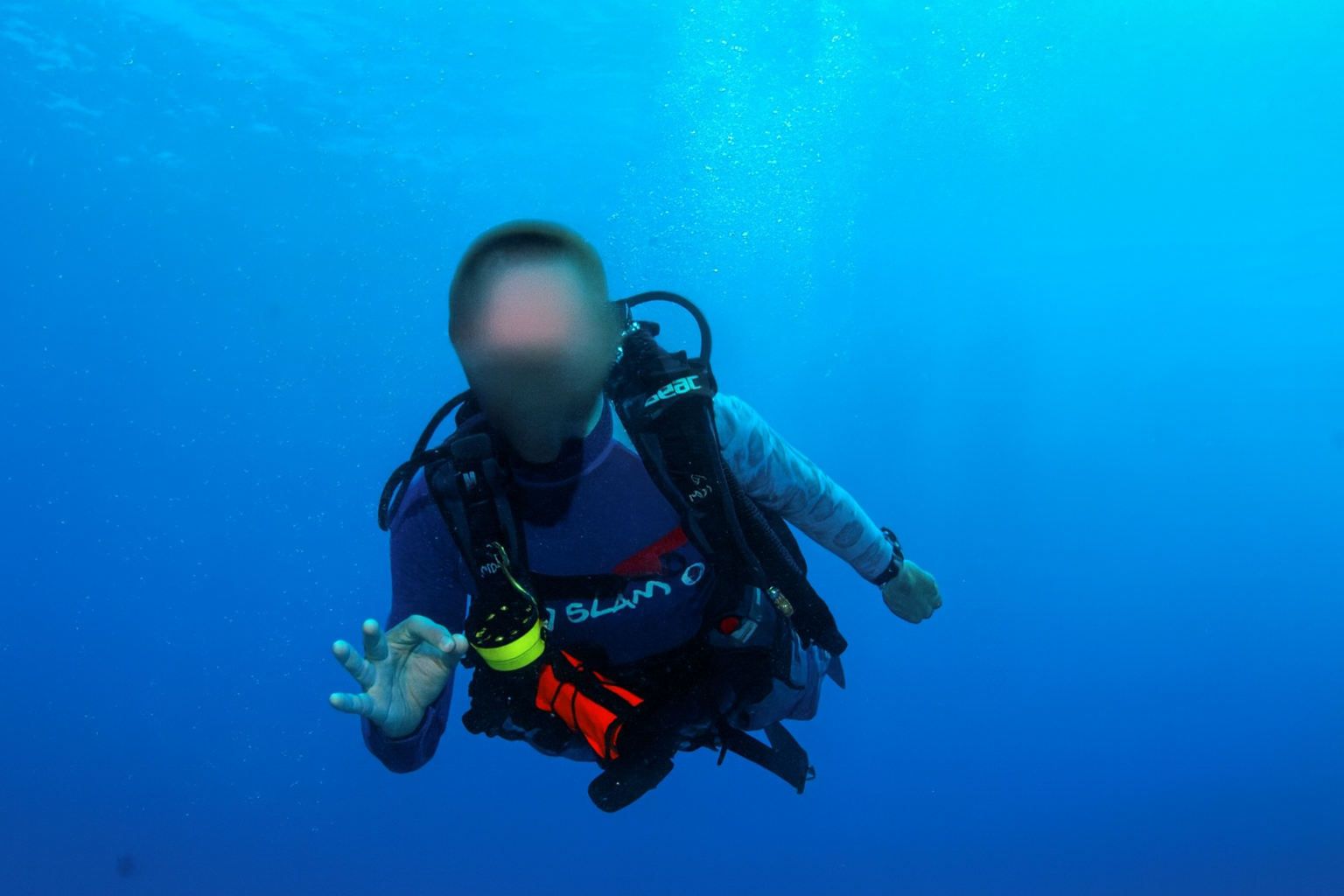
    I went back to Manta Dive, where I had done all my earlier certifications. It felt familiar, and I trusted the team. My group trickled in over a few days with people starting slightly before or after me. The people I connected with most were a Norwegian couple who were clearly doing well financially and were of a similar age. We got along instantly and ended up spending a few days day drinking together. On one of the later days, we were joined by a girl from Chile who became a close friend almost immediately.

    My main instructor was Kini. The official start time each day was 7:45 a.m, which honestly was a system shock for me. Some days I skipped, either because I had been out the night before, or because I was dealing with a sinus squeeze, a stye in my eye, or a mid-course trip to Bangkok for a conference. Diving every day is more physically and mentally draining than it sounds. I quickly learned I do not love scuba diving enough to do it every day from morning until night.

    Training and Skills

    The course is part apprenticeship, part endurance test. There are the obvious diving skills, like assisting teaching perfect buoyancy, mask removals, and navigation. Then there are the harder physical challenges, such as the 25 metre underwater swim. That one took me three attempts and left me gasping. learning backfinning absolutely sucked. I never mastered it.

    Much of the in pool assisting essentially ended up with me spending hours in the pool, simply observing total strangers complete the absolute basic of scuba skills whilst I just hung about a meter below the surface waiting for the class to be over.

    By the final weeks, things started to click. I passed my dive briefing and guiding evaluations on the first attempt, though I made sure the instructors knew I was on a tight schedule.

    I’d like to say I saw some incredibly exotic and interesting marine life, but this isnt a Disney movie. It was a lot of turtles and schools of assorted fish I still couldn’t identify with a gun to my head.

    I had previously seen a blue ringed octopus whislt diving at Gili, but no such luck on this course.

    The villa I stayed at. – Booking.com

    Moments That Stand Out

    The underwater proposal will always be my highlight. We staged it as a photo shoot so the bride-to-be had no idea. It was the worst kept secret in the dive centre, but we managed to keep her in the dark. At 30 metres, he pulled out the sign upside down before flipping it to read “Will you marry me?” She nodded, bubbles everywhere. Despite being probably more hungover than I should have been to dive, we did a negative entry from the boat and I dropped like a stone right to 30m. Despite being low on air I joined in blowing air from my reserve regulator in the background of the proposal photos. I surfaced nitrogen narced as fuck and low on air – I did an air-sharing ascent with one of the guides – and then went straight home and slept off the rest of my hangover.

    One dive after a few beers the night before I kind of got narced or something at a relatively shallow depth of 20-25 meters. I spaced out massively and remember looking at my heads like it was a dream, My mind raced nonsense words and gobbledigook phrases in English and German. Not sure what that was but I had no business diving and had to abort, come up, and go home and rest. Unfortunately for one of my fellow divemaster trainees, that was on his first dive as guiding, sorry, Andrius.

    One morning I lay in bed staring at my portfolio before heading to the dive centre and watched increased by a quarter of a million dollars in the space of around an hour. I walked in to the dive centre doing my best to act completely normal and keep the news to myself. But later that night I couldn’t hold my composure and ended up buying two bottles of champagne for the whole team. Over the eight weeks I bought six bottles in total, always at night after the diving was done, for birthdays, course completions, and just because I felt like it.

    I also bought two instructors brand new SMBs. One had lost his on a dive with me and he said his wife would kill him for it. The other had been joking for weeks that he would take mine after I left.

    What I Learned

    The Divemaster course made me a better diver, but not in the way I expected. The real mastery was not in the technical skills. It was in managing people, keeping them safe, and solving problems before they became emergencies. For me, that was the least enjoyable part.

    As my particular blend of autism often manifests in a complete lack of understanding the emotions or feelings of others, the constant interpersonal management was exhausting. Guiding a dive means you are not enjoying your own dive. You are scanning, counting, and adjusting the whole time. The sense of freedom I get when diving recreationally disappears when I am responsible for others.

    Would I Do It Again?

    Yes, but not to work as a professional. The Divemaster course is worth doing for the challenge, the skills, and the memories. It is not worth doing if you expect it to be a source of long-term joy or income unless you have the passion for diving every day and the patience for managing people.

    For me, it was the perfect first chapter in my post-work life. It gave me structure, pushed me physically. It made me comfortable in being generous with spending if it brightens people’s lives, and reminded me that even in the middle of a dive course, your portfolio can move by six figures and you need to walk into the dive centre as if nothing happened. That is the kind of autonomy I worked for.