fuck.
I came round on the floor.
I don’t know where I was. I don’t know how I got there. I don’t know how long I’d been down. Above me, uniformed, armed, police. Around me, a city that had carried on without me for some stretch of time I cannot account for and probably never will.
I lay there like a newborn. Not a metaphor: genuinely like something that had just arrived in the world and hadn’t yet worked out what any of it meant. Limbs that didn’t feel like mine. Lights that were too bright. Voices I couldn’t parse. A floor that was wet, or cold, or both.
I still don’t know what happened.
I asked the police. I asked the doctors. A fall, maybe. It had been raining heavily and Singapore pavements get slick.
Head lacerations. I can’t rule out a fight, though I have no memory of one and it feels less likely than going down hard on wet stone.
What I know is this: at some point in the evening I ceased to exist as a functioning person, and the next thing I knew I was horizontal with strangers standing over me.
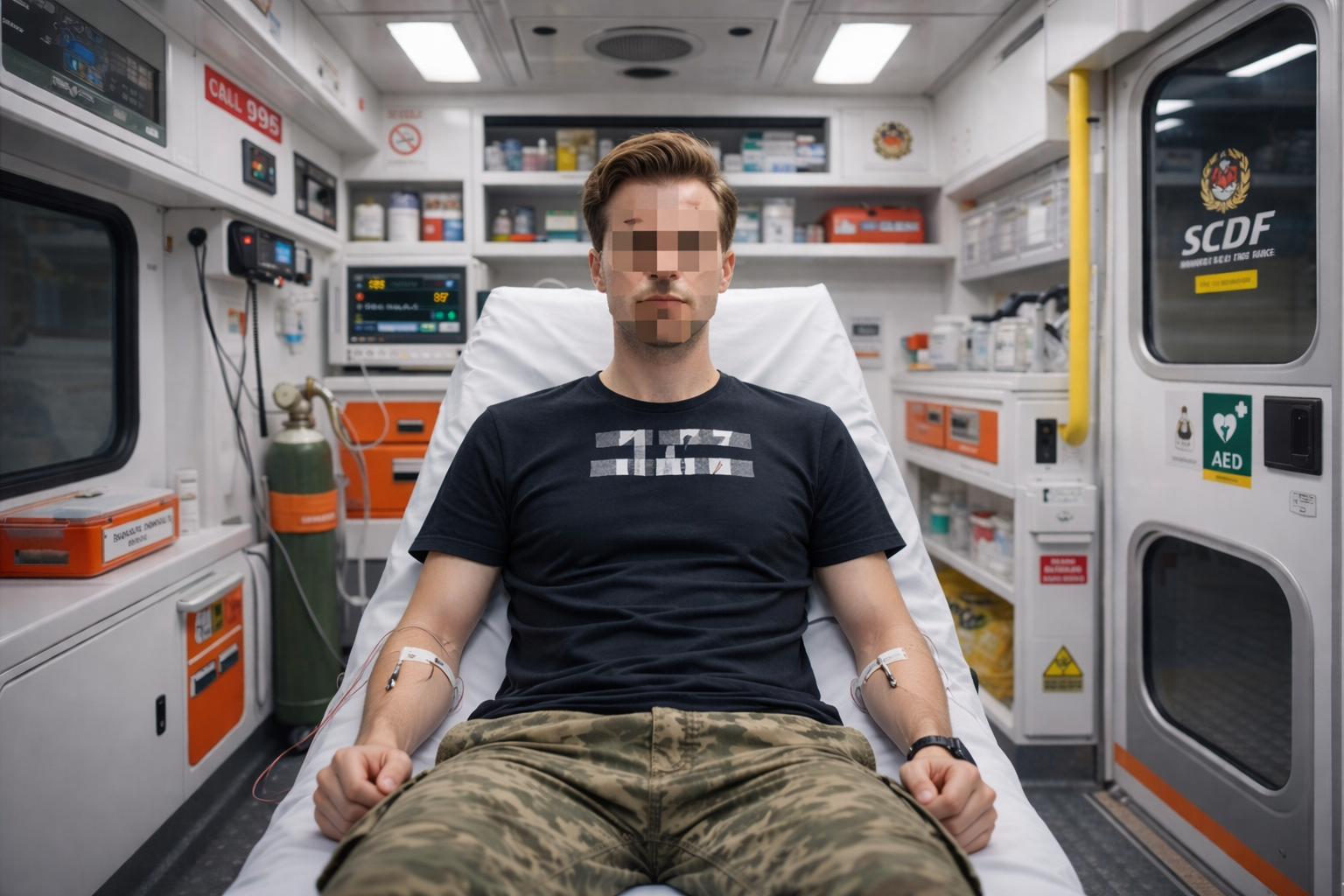
The paramedics checked my vitals. They weren’t good. I was taken in an ambulance to hospital, sedated, observed, marked as a fall risk. When I was released on the Wednesday morning the police called to ask if I was the victim of a crime.
I said no.
I have heard nothing since.
What I haven’t been able to shake is the shame.
Not about the drinking, though that’s there too. The specific shame of being a burden to the police. I was a police officer. I know what it costs: the time, the paperwork, the quiet judgment, the pragmatic patience extended to people who’ve made a mess of their evening and need managing. I was one of those people. I was the call that gets logged and forgotten.
I sent voice notes and videos from the hospital. I’ve played them back. I am clearly, comprehensively out of my mind. I cannot tell you whether it’s the concussion or the alcohol. Probably both. I watch myself and don’t fully recognise the person talking.
That’s not a comfortable sentence to write.
I’m in Singapore for a job. A good one.
A crypto company headhunted me, well-paid, the kind of role that doesn’t come around often. I’m performing well. I’ve been using AI to operate at a level I couldn’t have managed a few years ago. By every professional metric, things are going well.
I negotiated the role remote. Partly optionality (I always negotiate for optionality). Partly because I know, in the part of me that’s still honest, that I cannot stay in Singapore. If I stay here I drink. That’s not a theory. It’s a pattern I’ve watched play out in real time over eleven days, but also over the past 10 years with a trajectory that seemed only to go in one direction.
I tried, after the fall, to stay sober. I mostly failed. The structure here is friends (lads) and lads means going out, and going out means drinking, and once I’m drinking I don’t stop. I woke up one morning back at my hotel after dropping my stuff off at a friend’s place, with nothing but the clothes I was standing in. Phone dead. Watch dead. Card on my phone, so no way to pay for anything. No way to contact anyone. My whole life (every piece of it) in a bag I’d left somewhere else.
I yomped that bag across Singapore for eleven days. My whole life in a suitcase and a backpack, moving between hotels and friends’ floors and bars and hospitals. Never anywhere for more than a few nights. Never anywhere that was mine.
I am so tired of this.
I have built, by any reasonable measure, an extraordinary life.
Bitcoin changed everything. A concentrated bet that most people thought was stupid and turned out to be the best financial decision I ever made. Net worth that meant I never had to work again if I didn’t want to. Complete geographic freedom. No mortgage. No commute. No boss I didn’t choose. The number (the FIRE number) hit and kept going.
I have written about this life. I have described it honestly, I think.
The question beneath every post on this blog is the same question: Bitcoin got me here. Now what?
I have not, until now, answered it honestly.
The honest answer is: I don’t know. And the not-knowing has a texture that I’ve been trying to drink away.
───
The days I can convince friends to come out, I drink heavily. The days I can’t, I sit alone in hotel rooms watching YouTube.
Not documentaries. Not anything I’d recommend to anyone. Just content. Noise.
Light in a dark room. I use it the way other people use white noise machines: not because I enjoy it, but because I cannot bear the silence.
The silence means thinking. Thinking means the question. The question is: what is this for?
I have no answer. I have complete freedom and no answer, which turns out to be its own kind of prison.
My portfolio is down around three million dollars. Not ruinous (I know that, I can do the maths, I still have more than enough). But three million dollars is not an abstraction. It is the scoreboard of a system I built and believed in, and watching it fall quietly undermines the story I’ve been telling myself.
The story goes: you made the right calls, you took the right risks, the freedom you have is earned and real. A sustained drawdown doesn’t break the story, but it puts pressure on it. It makes the silence louder.
I wrote a post a while back called The Call to Serve. I stood in a cold football ground and listened to army recruiters and felt something shift inside me.
Not nostalgia. Recognition. The pull of structure, legitimacy, being needed. I started to drive to the army careers office to find it had been closed for years. I ate a sausage roll in my car and went home and watched television.
I ended that piece asking: is this what winning looks like?
I’m asking it again. With more weight behind it this time.
The thing nobody writes about in the FIRE space (and I mean nobody) is what happens when freedom turns against you.
The literature is full of accumulation. The number. The day you hit it.
The transition. The travel, the optionality, the liberation from the nine to five. It is written, almost universally, as arrival. You spend years in motion toward the destination and then you get there and the story ends.
It doesn’t end.
What happens is this: you remove every external constraint and discover that external constraints were doing more work than you knew.
The job you hated told you when to wake up. The commute you resented gave you a transition between states. The colleagues you complained about were, in the most basic sense, people who needed you to show up. Remove all of that and you are left with pure freedom and the question of what to do with it, and if you don’t have an answer ready the freedom starts to curdle.
I built my life around optionality. Every decision optimised for keeping options open. Remote work. No property. No fixed geography. Maximum flexibility, minimum obligation. I told myself this was sovereignty. In many ways it is.
It is also, I am sitting in a hotel room in Singapore admitting, a life with nothing that requires me to be anywhere in particular, doing anything in particular, for anyone in particular.
I am unrequired. I wrote that in a previous post and meant it philosophically. I mean it more personally now.
On Wednesday morning I walked out of a Singapore hospital with head lacerations and a discharge summary and a phone full of messages from people who’d watched me dissolve in real time via voice note.
I booked a villa in Bali. Two months. I’m going sober.
I’m not writing this as a recovery story because I don’t know yet if it is one. I’m writing it because the opposite of honesty is the version of this blog where I describe the freedom and the Bitcoin and the portfolio and the travel and leave out the floor.
The floor happened. The police happened. The shame happened. The YouTube videos at 3am happened because the silence was too loud and I didn’t know what else to do with myself.
I have everything I set out to have.
I came round on the floor.
I’m still not sure those two facts are unrelated.
Saturday. Bali. Fly right.